First published on Tuesday, December 2, 2025
Last updated on Tuesday, December 2, 2025
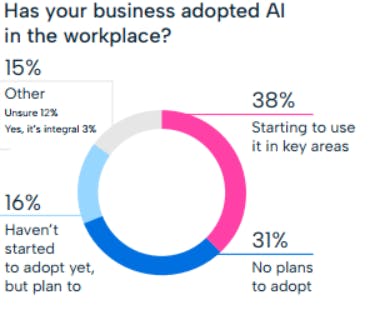
Thanks to our AI pulse report survey, we’ve uncovered that 76% of Canadian businesses are positive about adopting AI. And in 2025, 57% have put plans in place to adopt AI or have already started. With this in mind, how are businesses using AI in HR?
In this blog, we’re discussing whether the latest surge in use of generative AI can replace HR teams and why keeping the human is HR is so important. Plus, we’re offering some tips on how to safely and efficiently integrate AI into your business.
The benefits of using AI in HR
AI tools such as ChatGPT and Gemini offer a whole host of capabilities. From writing emails to answering complicated questions, they have been adopted globally to help business owners cut costs and save time.
For small Canadian businesses, adoption of AI in HR could mean:
Less time spent on manual admin tasks
Optimized workforce management
More time to focus on wider projects
Higher productivity rates as teams tick off tasks faster than ever
Greater scalability opportunities for smaller businesses
The challenges of integrating HR with AI
There's no denying that AI is transforming the world of work, and while it brings plenty of exciting opportunities for HR teams, it’s important to recognize the considerations that come with adopting new technology. With the right planning and guidance, you can manage these challenges effectively and even turn them into long-term advantages for your business and your people.
Evolving job roles
AI has the potential to streamline repetitive tasks, allowing HR teams to focus on more meaningful, people-focused work. Rather than replacing HR roles, AI can free up time for strategic projects, employee engagement, and organizational development.
For small businesses, AI tools provide much-needed support where dedicated HR roles don’t yet exist, helping owners stay compliant and save time.
Governance and legal compliance
As governments work to keep pace with the rapid growth of AI, guidance and legislation continue to evolve. While this can create some uncertainty, it also means businesses have the chance to lead the way in managing responsible and transparent AI use.
In HR, where fairness, equal opportunities, and legal compliance are essential, clear policies and good governance help ensure AI supports decision-making without replacing human judgement.
Ethical considerations
Protecting employee data is still a top priority, and AI can actually strengthen this when used correctly. Many tools come with robust security features, helping businesses organize information safely and consistently.
By choosing trusted systems and reviewing processes regularly, you can continue to meet your ethical and legal obligations while benefiting from modern technology.
Supporting your people through change
Introducing AI can raise questions for staff, but it also creates opportunities for growth and skill development. With open communication and the right support, employees often feel more confident and positive about new tools, especially when they see how AI can remove admin pressures and enhance their day-to-day work.
Real-world examples
There are already many examples of AI being used within HR, and while these tools can be incredibly useful and timesaving, they don’t always deliver the right experience for every candidate or situation.
Take a recent example from the UK, a candidate Richard Stott declined an interview after learning it would be conducted entirely by AI . He felt that the lack of human interaction suggested the business didn’t value his time or effort and chose to withdraw from the process.
In doing so, the company may have lost out on a highly qualified applicant. This highlights an important point for employers. While AI can streamline recruitment and reduce administrative workload, candidates still expect a human connection during the hiring process. Without that personal touch, businesses risk creating a poor first impression and discouraging strong talent from moving forward.
How do businesses feel about AI?
As Google’s Sundar PichAI warns people should not “blindly trust” everything AI tools tell them, there are certainly risks counterbalancing the rewards of using AI in the workplace.
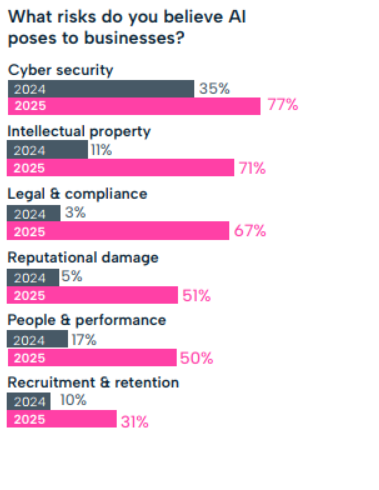
Data from our AI report found that 77% of businesses say they are concerned about cyber security, while 67% are worried about the legal and compliance risks.
Despite a lot of positive rhetoric surrounding AI, business owners are seemingly more concerned about the risks than initially believed. Many are hesitant to adopt AI for the sake of their business’ reputation, performance and staff retention rates.
In fact, our survey found that legal compliance was a much bigger concern for business owners in 2025 than in 2024, with 67% of businesses now stating this as a risk AI poses to their business. A further 50% were also worried about reputational damage. Below, our graph shows the exact data:
For small businesses tackling employment legislation alone, AI cannot replicate the valuable advice and guidance of genuine HR and legal experts. But it can be adopted to make life easier.
How can you safely integrate HR with AI?
As AI becomes a part of our lives, there’s no stopping it's integration into human resources. However, this doesn’t mean we should avoid approaching with caution.
Without clear guidance, HR teams may struggle to understand how to stay compliant while leveraging AI responsibly, especially when it comes to data protection, fairness in recruitment, and avoiding discriminatory outcomes.
Before introducing AI into your HR processes, it’s important to consider how you’ll manage it responsibly. This includes protecting employee data, ensuring fairness in recruitment, preventing discrimination, creating clear policies, and training staff on proper use. By putting the right governance in place from the start, businesses can use AI safely, ethically, and in line with legal requirements.
Prioritize cyber security
Having robust cyber security policies and procedures is essential to protect your employees and your business. Whilst also ensuring compliance with data protection laws. Businesses using AI to support admin tasks should err on the side of caution when handling sensitive employee data.
Provide support and training
During this time of technological development, employees may seek support and reassurance from managers to understand how AI is intended to be used by the business and what this will mean for their job roles. Manager and employee training on the topic of AI could be incredibly valuable for your team.
Restrict reliance on AI tools
The dehumanization of the workplace has become a topic of ethical debate with many business owners concerned about the lack of human autonomy and human contribution to serious decision-making processes.
With too much reliance on AI in HR, your business could lose its “human touch”. Restricting access to AI tools exclusively to employees who need them will allow your business a chance to adapt to the modern way of working while maintaining the human elements of your business that make it unique.
AI at BrightHR
Choosing the right tool is key to harnessing the power of AI the right way.
it’s all about making the choices that support business growth:
It’s one thing to use AI to save time in a task for a person. It’s another thing to drive operational productivity and performance improvements which only comes if the AI tooling is embedded into the software and business processes end-to-end.
At BrightHR we are supporting small businesses by embedding AI into our HR tools without removing the human element of our services. From recruitment to performance management, discover how we have enhanced our HR software with AI to deliver even more powerful products and features to streamline and automate your HR.
To find out more about how we are embedding AI into our HR software, watch the video and download our pulse report.