
Toni Houghton
Thursday, July 24, 2025
Jump to section
Slipping, tripping or falling can cause injuries like back problems,broken bones or head injuries.
Making up the majority of non-fatal injuries at work, slips, trips and falls are accidents that absolutely must be addressed in your workplace risk assessments.
In this guide we explore how you can prevent slips, trips, and falls from occurring.
Where do the most common slips, trips and falls occur?
Slips and falls can happen anywhere, but public areas are some of the worst places for them. This includes retail stores, restaurants and medical centres. Typically, they are high footfall areas where there tends to be a greater number of hazards.
Some sectors tend to report higher numbers of employee trips and falls. Including hospitality, healthcare, construction, retail and agriculture.
With injuries like this reported to cost an estimated £512 million each year for businesses, it is vital that measures are implemented to reduce risks.
Examples of slips, trips, and falls
Cables
Cables are particularly dangerous and can easily become a trip hazard when left in the wrong place or trailing along the floor. Workplaces such as offices are often big culprits for this one. Usually not taking the correct precautions to keep electrical cables neat and tidy.
Poor lighting
Poor lightening makes it hard for people to see where they are walking. This can cause slips, trips and falls.
Uneven flooring
If flooring is poorly laid or the surface is uneven it can quickly become a trip hazard. This includes when a mat or protective layer has been laid but not secured, causing the surface to slip and slide beneath a person’s feet.
Insufficient footwear
Footwear at work can make all the difference when it comes to preventing an accident. In higher-risk work environments, like building sites, hospitals, and kitchens, the right footwear may include non-slip shoes or steel-toe capped boots for protection.
Wet surfaces
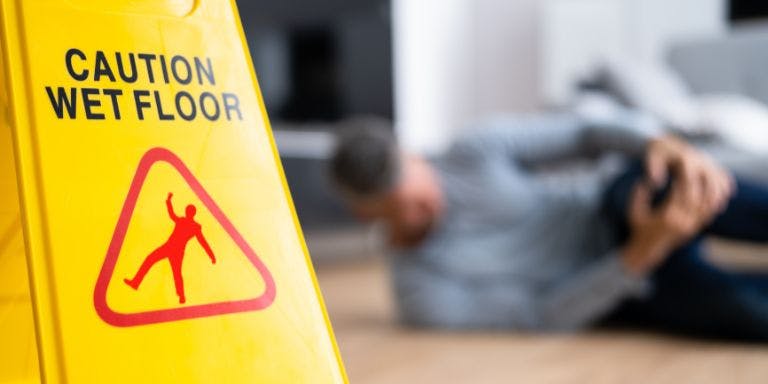
Wet floors can be a major hazard that can lead to slip and fall accidents. Therefore, wet floor signs are essential when warning employees of wet walking surfaces. Otherwise, it can take just seconds for an employee to slip on a wet surface and break bones or severely injure their back or head.
Poor or no safety signage
Safety signage, like wet floor signs, indicate the presence of a hazard like a spillage or wet floor. Without them you could find yourself in hot water with the HSE. The Health and Safety (Safety Signs and Signals) Regulations 1996 outline your specific requirements as an employer.
Dust on floors
Dusty floors can be just as bad as wet floors. In fact, dust can cover and hide all sorts of trip hazards. In environments where dust is a common occurrence it is vital you take every step possible to keep the walkways clear and clean. This includes regular housekeeping such as sweeping and dusting.
Why do businesses ‘slip up’?
Businesses often overlook the trivial things that could cause serious injuries for employees. Underestimating the impact things like cables, poorly kept floors, and poor lighting can play in causing slips and trips in the workplace.
Often overlooked for what are deemed “more serious” hazards, the correct safety measures may not be implemented. Resulting in both minor and major injuries. Causing both reputational and financial damage to a business while an employee will suffer incalculable damages, potentially resulting in the loss of earnings and even the ability to continue within their job role.
Your responsibility as an employer
It is your responsibility to set up proper health and safety procedures in your workplace. To protect yourself and your staff.
Under The Health and Safety at Work Act 1974 you are legally required to provide a safe working environment. This includes identifying hazards, such as those which may cause slips, trips and falls at work.
In addition, the Management of Health and Safety at Work Regulations 1999 and the Workplace (Health, Safety and Welfare) Regulations 1992 emphasise the importance of safe workplaces by requiring employers to conduct risk assessments and maintain safe conditions.
Specifically, these regulations mandate that floors and traffic routes be suitable for their intended use, kept free from obstructions, and have adequate drainage where necessary.
Therefore, as an employer you must:
Identify slip hazards with a thorough risk assessment
Implement safety measures to reduce these hazards
Train staff on how to mitigate risks
Provide PPE such as non-slip shoes as part of uniform (where applicable)
Use safety signs to warn employees of hazards such as uneven flooring, trip hazards, and spillages
Building designers and architects
In some respects, the initial stages of building development should also take into consideration the risks of slipping on surfaces.
For those who have direction over the development of a building, steps should be taken to ensure that walking surfaces are accessible for all users and do not pose a risk. The HSE specify issues such as floor finishes and levelling as issues that need to be addressed during the planning and development stages.
Do not fall short when it comes to safety
It is your legal duty to stay compliant with health and safety laws. Taking a proactive approach to keeping staff safe. Without proper risk assessments and safety measures in place you can quickly find yourself dealing with the consequences of accidents at work.
With slips, trips and falls often overlooked, you may not realise just how dangerous they can be. Yet, preventing them can be simple.
With the support of BrightSafe, all-in-one health and safety software, you can make sure that the right risk assessments is conducted and staff and managers are trained on the many common trip and slip hazards.
On top of this, the health and safety advice line are available to answer questions you may have regarding things like PPE, health and safety signage, and what to do if an accident does occur.
To find out more see our video below for an in-depth tutorial of all BrightSafe features: