
First published on Friday, February 6, 2026
Last updated on Friday, February 6, 2026
If you're constantly writing job ads, printing contracts, and explaining how the till works to someone new every other week, you’re in good company. But let’s be honest: the revolving door routine is exhausting and expensive.
And in 2026, when 63% of hourly retail workers say they’re planning to leave, doing nothing about retention just isn’t an option. So what if you could plug the leak?
What if employees stayed, supported company growth, and maybe even walked out smiling at the end of their shift? Let’s talk about how to make that happen.
Why they leave (hint: it’s not just the pay)
Retail employees aren’t walking away because they hate folding jeans. They’re walking because:
Their rotas are a mess
Training is a shrug and a name badge
No one says ‘well done’ ever
They can’t swap shifts without a million messages
They feel invisible until they resign
Good news? Every single one of those reasons is fixable.
Even better: you don’t need a full-time HR team to fix them. You just need a plan and a clever HR software.
5 HR tweaks that make people stay
1. Nail the onboarding (first impressions stick)
Let’s skip the awkward ‘just follow Beth’ approach.
Onboarding should feel like your team knows what they’re doing. Because when people feel welcome and clear on what’s expected, they tend to stay.
Try this:
Set up a digital checklist for every new hire
Auto-send contracts and policies before their start date
Assign mini-training tasks they can tick off
Schedule a 7-day check-in (not optional, not awkward)
2. Give them some say in their shifts
Rigid rotas are the silent killer of morale.
People have lives. They’ve got dogs to walk, kids to collect, exams to sit. When staff can’t shape their schedule even a little, they’ll shape their exit.
Fix it by:
Allowing staff to share their availability on the go with mobile apps
Making it easy to swap shifts (without 12 texts and a Facebook group)
Sharing real-time rota updates so no one’s caught out
3. Show appreciation (it’s free and it works)
Ever quit a job because no one noticed you existed?
Recognition doesn’t need to be dramatic. A little 'great job today' or 'thanks for covering that shift' goes a long way, especially in busy retail environments.
Try using:
Peer-to-peer praise boards
Monthly shoutouts or MVP badges
Automated work anniversary messages (with a treat?)
4. Ask for feedback (and mean it)
People leave quietly, until they don’t.
If you’re only hearing feedback at the resignation stage, you’re already late. But if you build in check-ins, surveys, or anonymous boxes, you’ll catch any issues before they can get out of hand.
Set up:
Monthly pulse surveys
Feedback forms after onboarding
Quick questions like 'What’s one thing we could improve?'
5. Track who’s leaving and why
Let’s be honest: most SMEs don’t know their turnover rate. Or if they do, they’re not entirely sure what to do with it.
But imagine knowing:
Which department or shop has the most leavers
When people are most likely to quit
Whether it’s the same manager every time
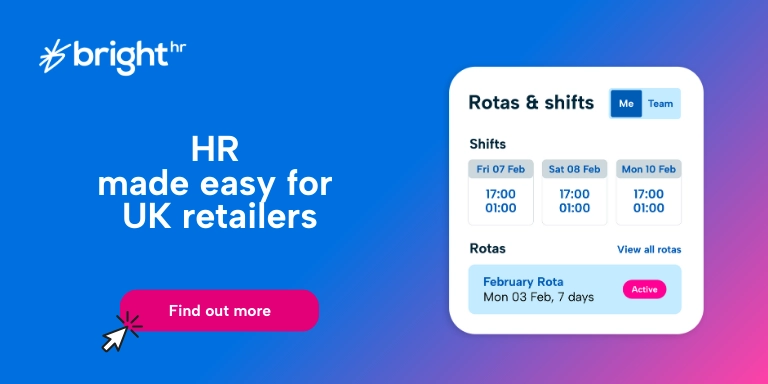
HR software can’t hug people, but it can help you keep them
You're not losing staff because you're a bad boss. You're losing them because retail is tough and the tools you use to manage people haven’t kept up.
An all-in-one HR platform helps you:
Smooth out onboarding
Streamline rota chaos
Recognise effort automatically
Hear staff before they go quiet
See turnover patterns before they become trends
And it frees up time for running the actual business.
Want a team that doesn’t disappear every quarter?
You're not alone. But you can be the shop that people talk about for the right reasons.
Let’s stop the revolving door before it swings off its hinges.