First published on Wednesday, September 30, 2026
Last updated on Wednesday, September 30, 2026
Welcome to HR Heartbeat, where we take a look at the most pressing HR and employment law stories. With over a decade of experience working within the HR and employment law industry, I give my opinion on current trends impacting your business, as well as my own personal commentary on all things HR and legal.
New French-language rules for federally regulated employers
The federal government recently proposed new regulations to expand French-language rights for employees and consumers in some federally regulated private businesses. These new rules will cover federally regulated businesses with 25 or more employees in Quebec. They'll also cover businesses that have 100 or more employees across Canada in regions with a strong francophone presence.
If your business falls into any of these categories, it could mean you'll not only have to change how you communicate with your employees but also how you manage workplace documentation.
These new French-language requirements would cover areas like employment communications, workplace policies, contracts and other documents, alongside employees' rights to work in French.
If you have a larger organization, you may need to establish a committee to promote the use of French in the workplace. In Quebec, this would mean businesses with 100 or more employees. For designated francophone regions, different thresholds would apply.
The proposed changes are scheduled to take effect first in Quebec, followed by designated francophone regions two years later. The regulations are still part of the federal regulatory process, so employers should keep monitoring developments and begin assessing whether the proposed requirements could apply to their business.
B.C. expands job-protected leave for Canadian Armed Forces reservists
Employers in British Columbia with staff serving as Canadian Armed Forces reservists now have a significantly longer job-protected leave entitlement to keep track of.
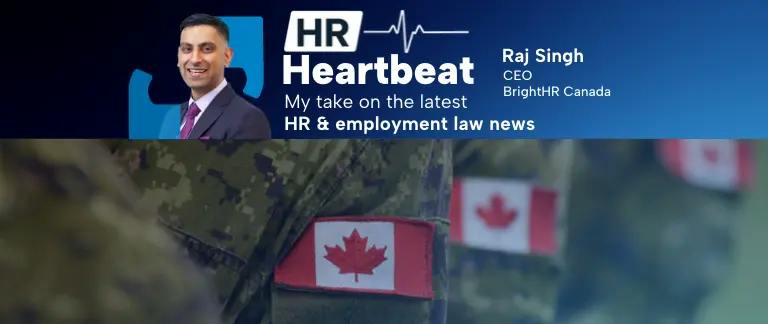
Starting August 6th, 2026, amendments to B.C.'s reservist leave regulations replaced the former 20-day annual training leave limit with up to 24 months of combined leave in a 60-month period. The expanded entitlement covers training, deployment preparation and deployment.
This means employers must review leave policies and track leave management processes to accommodate potentially extended absences. Reservists are generally required to provide at least four weeks' notice of training or deployment, but when a deployment is ordered on short notice, reservists must provide notice as soon as possible.
An important distinction employers need to keep in mind: deployments within Canada for national emergencies, such as wildfire or flood response, are exempt from the 24-month cap and are not counted towards the employee's leave entitlement. These absences must therefore be tracked separately from the employee's regular reservist leave entitlement.
That's why it's important to have a robust leave tracking system to easily keep track of distinct leave entitlements in line with relevant legislation.
Saskatchewan trucking company faces charges over foreign worker recruitment
A Regina-based trucking company and one of its representatives are facing criminal charges after Saskatchewan authorities accused them of misleading foreign workers about the jobs for which they were recruited.
The company and its representative each face three charges under Saskatchewan's Foreign Worker Recruitment and Immigration Services Act (FWRISA). They're accused of distributing false or misleading information and misrepresenting employment opportunities, including duties, wages, benefits and length of employment. They're also accused of taking unfair advantage of foreign nationals' lack of experience or knowledge.
This case highlights the compliance risks employers are exposed to when recruiting international workers, especially if they use third-party recruiters.
As a business owner, it's crucial to frequently review how you recruit and onboard foreign workers. Make sure your job offers correctly reflect the role, duties, wages, benefits and working conditions of the position you're looking to fill, and that records of everything are kept on file. And if you work with recruitment partners, ensure they're also working to the same standard.
Keeping recruitment records, contracts and worker communications accurate and consistent helps you demonstrate compliance if your recruitment practices ever come under scrutiny.
And that’s a wrap from me. Come back next time for my take on the latest headlines and employment law stories, helping keep your business ahead!